

Step forward if you’ve never heard that teething in infants can be associated with teething fever, diarrhea, and perhaps other symptoms such as skin rashes or seizures.
In this case, as in others, medical notions from antiquity have become part of common thinking, passed down from generation to generation for hundreds of years.
Sometimes even through us doctors.
Like the dreaded “cold shock.”
Where does “teething fever” come from?
Let’s start from the origins, calling on none other than Hippocrates of Cos, yes, the one from our oath.
In the XXV aphorism of his III book, he wrote:
“As teething approaches, there occurs restlessness in the gums, fevers, convulsions, diarrhea; these ailments are worse in those whose canine teeth are erupting, in those who are well-nourished, and in those with constipation.”
But what is the real situation?
For this, as for all other medical questions, in order to establish whether a hypothesis is true or false, we can use scientific literature.
Are some studies in favor?
Doing this (with the care to select authoritative studies published in similar journals) on the issue of teeth and complications, one encounters studies with small numbers, sometimes contradictory, at least apparently, but all agreeing on one important conclusion (which we will see at the end).
A study with few subjects and some errors
A prospective study from 1992, conducted on a small number of patients, analyzes the relationship between fever and the eruption of the first deciduous incisor. Of 46 children examined (few!), 20 had a rectal temperature above 37.5°C on the day of tooth eruption, and in 15 it was above 38°C.
The authors therefore concluded that tooth eruption causes a rise in rectal temperature above 37.5°C at a statistically significant rate compared to the days before the eruption, hypothesizing that fever and other symptoms could be related to the process of gum resorption, then ceasing once eruption was completed.
But let’s not forget that rectal temperature is itself 0.5-0.6°C higher than axillary temperature!
The results of another study
In another study from 2000, 125 parents were asked to record tooth eruption, tympanic temperature, and any associated symptoms daily starting from the fifth month of life and up to 1 year (for a total of 8 months).
During a total of 19,422 days of observation, 475 tooth eruptions were recorded.
Symptoms were significantly more frequent in the 4 days before tooth eruption, on the day of eruption, and in the 3 days following, defining this time window as the “teething period.”
In about 1/3 of children, during this period, the following were observed:
- tendency to bite
- hypersalivation
- gum rubbing
- sucking
- facial skin rashes (caused by saliva irritation)
- decreased appetite for solid foods
- slight increase in temperature
Nothing strange!
These symptoms, however, manifested during teething in only about 20% more children compared to children not teething.
Of the 125 children observed for 8 months each, none ever presented, during tooth eruption, a temperature above 39°C.
Symptoms such as:
- nasal congestion
- sleep disturbances
- increased quantity of bowel movements and decreased consistency
- drinking less
- cough
- skin rashes different from facial ones
- fever above 38.8
- vomiting
were NOT significantly associated with tooth eruption. Unfortunately, I couldn’t find the full text of the study to verify the percentage of children with fever.
What are our certainties
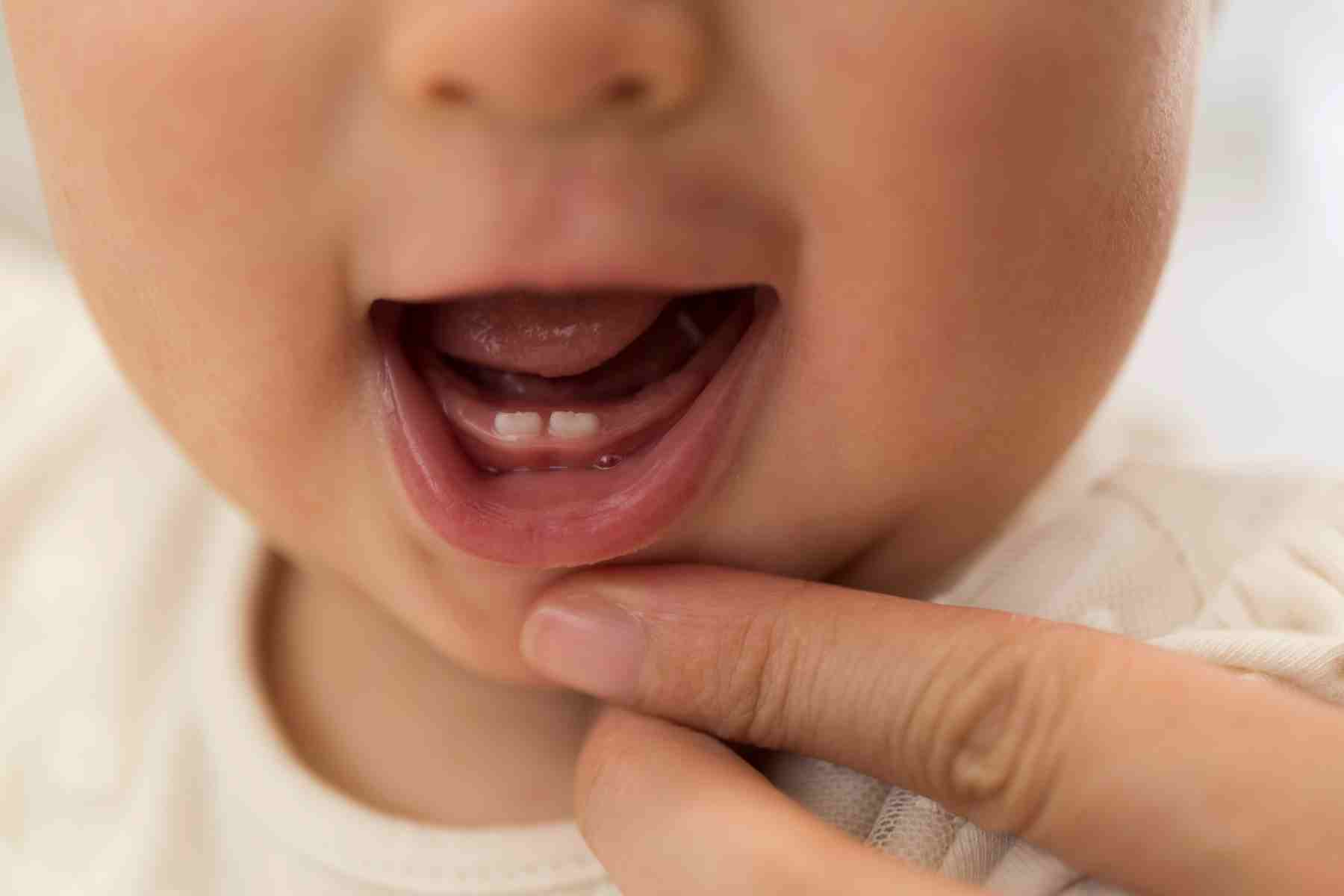
Teething certainly causes pain, and for this reason it manifests with drooling (excessive salivation, as also in case of pharyngodynia, which would be sore throat), crying, and restlessness.
In this condition, as in all others concerning children, pain MUST be treated.
Of all the related symptoms reported above, the only one that, besides pain, deserves attention from parents and pediatricians is certainly fever which, if of infectious origin, could be underestimated if we used the teeth alibi: “he has a fever because his teeth are coming out.”
A useful example.
I’m thinking, for example, of an infant (child from 1 month to one year of age; a newborn, on the other hand, is a child less than 30 days old), with fever (axillary temperature above 38°C, before which one should more correctly speak of low-grade fever).
If we attributed its origin to teething, we might, for example, not think about, and therefore not diagnose and not treat, a urinary tract infection which, in infants, typically presents with fever in the absence of other symptoms, and which could lead to serious consequences.
Not to mention that it would not be possible to exclude with absolute certainty that the low-grade fever present during teething is instead caused by a trivial viral infection.
Always and in any case to be avoided, in conclusion, is the attribution of fever to teething.
We are with you
We at Parentalife are by your side throughout the journey of parenthood, from the fertile period, to pre-delivery and life with children.
We support you with guides, courses, and with personalized consultations.
Remember, we are with you.
SOURCES
1. https://pmc.ncbi.nlm.nih.gov/articles/instance/1793425/pdf/archdisch00641-0087.pdf
2. https://publications.aap.org/pediatrics/article-abstract/105/4/747/65718/Symptoms-Associated-With-Infant-Teething-A?redirectedFrom=PDF